
What this service covers
Protect potable water with the correct assembly and documentation.
Miami properties can need backflow containment for irrigation, commercial processes, fire protection, multifamily systems, or specific hazards. Assemblies exposed outdoors face heat, salt, impact, flooding, and landscape interference. A leaking relief valve should not simply be capped.
Signs it is time to request backflow prevention
The pattern, timing, and number of affected fixtures often tell more than the loudest symptom. These signs are reasons to schedule diagnosis, not proof that the most expensive repair is necessary.
- A utility sends an annual test notice
- An assembly leaks or discharges
- A renovation changes the water-use hazard
- Irrigation or commercial equipment needs protection
- A failed test requires repair and retesting
How BH Plumbing & Drain Service approaches the work
Each appointment moves from protection and diagnosis to an approved scope, completed work, and verification. The exact equipment and tests change with the system, but the decision path remains clear.
Listen and protect the work area
We start with the symptoms you have noticed, protect nearby floors and finishes, and identify any immediate shutoff or containment step.
Confirm device type, authority, certification, and reporting needs
The technician checks the accessible system, tests the likely causes, and explains what the evidence shows before recommending work.
Test, repair, replace, or coordinate the approved compliant scope
After you approve the written scope, the repair or installation is completed with attention to clean connections, safe operation, and the surrounding property.
Verify and explain
We operate the system, check for leaks or restored flow, clean the work area, and explain practical steps that may help prevent a repeat problem.
What is backflow prevention?
Backflow prevention keeps non-potable or contaminated water from reversing into a potable supply when pressure changes. The required assembly depends on the connection, hazard, utility rules, and applicable plumbing or fire code.
Different devices are not interchangeable. Orientation, drainage, clearance, protection, and test access must follow the listing and authority requirements.
Who can certify a backflow test?
The water authority or jurisdiction generally requires a tester with accepted current certification and calibrated equipment. Before scheduling, confirm that the assigned person can perform and submit the exact required test.
BH Plumbing & Drain Service does not publish an unverified tester credential. Qualification and reporting responsibility are confirmed for each request.
Why is my backflow assembly dripping?
Discharge can result from debris, worn checks, pressure changes, failed components, improper installation, or a condition the relief valve is designed to reveal. Capping or bypassing the discharge defeats protection and can be unsafe.
The assembly type, pressures, shutoffs, drainage, and downstream use should be checked before parts are ordered.
What source, service, and hazard require backflow protection?
Backflow protection begins with the water purveyor, service connection and cross-connection hazard—not a device chosen from appearance alone. Identify the public supply, meter and customer premises; then separate domestic, irrigation, fire, reclaimed, well, boiler, process and chemical-feed connections. Backpressure or backsiphonage potential plus the hazard classification determines what the utility and adopted code require.
A containment assembly at a Miami-Dade WASD service protects the public system from conditions on the customer’s premises; internal fixture or equipment protection can be a separate plumbing requirement. Record the serving utility, account/service, meter, size, use and exact connection before assuming a County form or interval applies. A domestic service to a multifamily, medical, laboratory, food, industrial or mixed-use property can present a different hazard than a detached residence. Irrigation may use potable, reclaimed or private-well water and can include fertilizer or chemical injection. Fire protection has separate water-supply, impairment and contractor requirements. Boilers, cooling equipment, treatment systems, beverage equipment, pools, docks and process piping can create distinct backpressure or backsiphonage conditions. A condo may place the assembly on common property while a unit contains additional protected connections; the declaration, plans, utility record and management authority define access and responsibility. A cross-connection survey evaluates these relationships; a field test of one assembly only measures that assembly’s testable functions and cannot certify every downstream connection or the entire premises.
How do RP, double-check, PVB, SVB, and air-gap protection differ?
An RP/RPZ assembly can address high- or low-hazard backpressure and backsiphonage through two checks and an intermediate relief zone. A double-check assembly is limited to low-hazard conditions. PVB and SVB assemblies address backsiphonage only. A compliant air gap is measured physical separation. The utility, hazard, service, code, listing and approved orientation control selection.
A reduced-pressure principle assembly conforming to the applicable standard has shutoffs, test cocks, two independent checks and a relief function between them. Its relief opening must remain unobstructed, discharge through the required separation and have drainage planned for the model’s possible flow; capping a discharge or submerging the opening defeats the design. A double check valve assembly can protect against backpressure or backsiphonage only where the authority accepts the condition as low hazard. Detector versions serve specific fire-protection arrangements and are not interchangeable with ordinary domestic or irrigation assemblies. A pressure vacuum breaker or spill-resistant vacuum breaker protects against backsiphonage, not backpressure, and its elevation, orientation, continuous-pressure suitability, drainage and downstream configuration must follow its listing and approved application. An atmospheric vacuum breaker, hose device or equipment-specific preventer has another scope and may not be a substitute for a testable service assembly. A code air gap is the vertical separation between the potable outlet and flood-level rim, sized and installed to its referenced standard; an open pipe near a drain or the air space below an RP relief port is not automatically that protection method. Verify make, model, size, serial number, standard, orientation and current utility acceptance rather than calling every two-check device an RPZ or every irrigation valve a PVB.
What is the difference between an inspection, field test, repair, replacement, permit, and report?
A visual inspection records installation and accessible condition; a cross-connection survey evaluates hazards and protection; a field test uses a calibrated kit and assembly-specific procedure to record check, relief or air-inlet performance. Repair changes components, replacement changes the assembly, permit inspection reviews approved work, and the utility report records the qualified tester’s actual result. None substitutes for another.
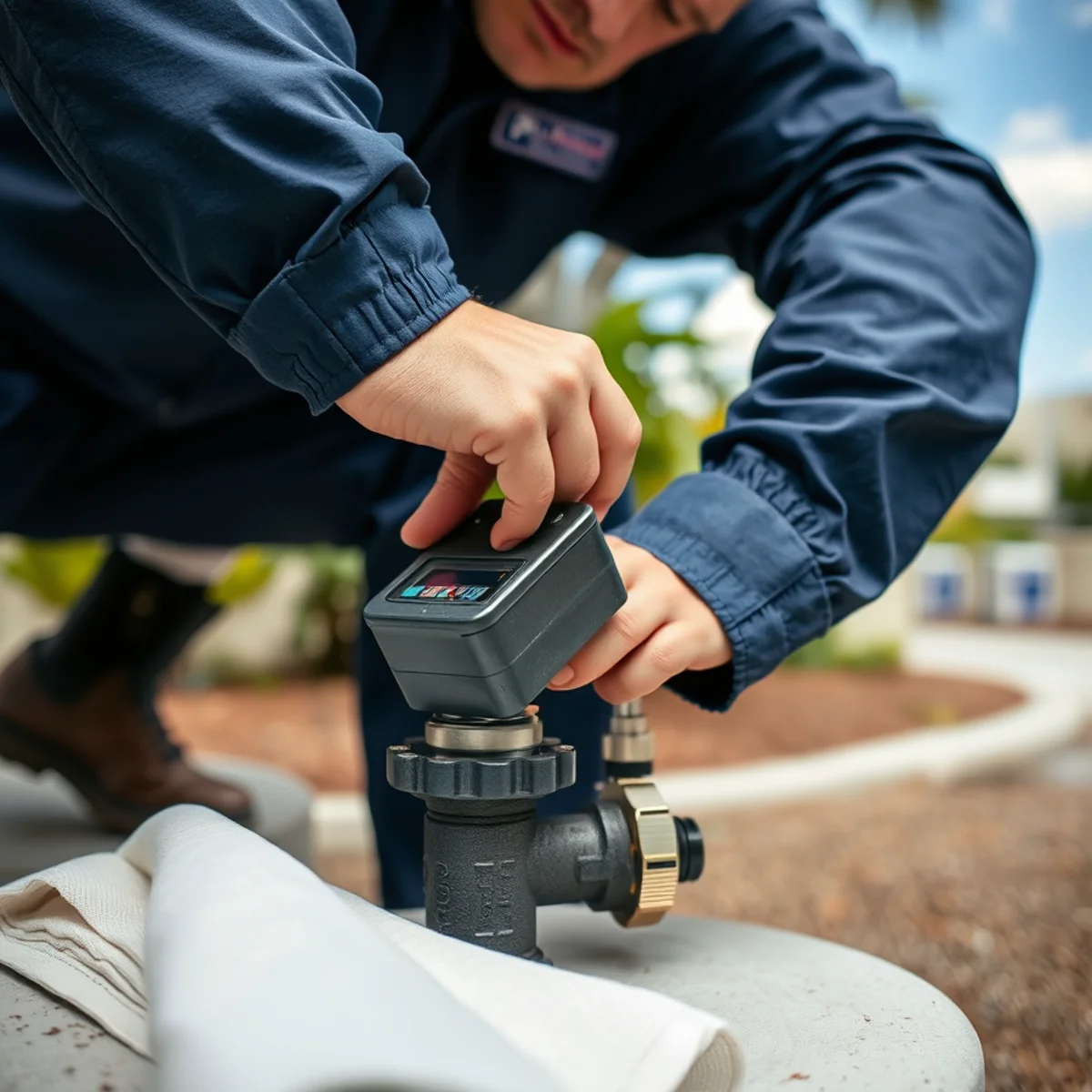
Before a field test, verify the assembly identification, service, orientation, test cocks, shutoff condition, access, drainage and the correct current report. Notify the owner about the test sequence and likely interruption because isolating the assembly can affect fixtures, irrigation, tenants, equipment or a pressure zone. The tester attaches a current calibrated differential-pressure kit and performs the procedure for the identified RP, DC, PVB, SVB or other accepted testable assembly, recording observed values and pass/fail conditions—not an estimate from visual appearance. A failed check, relief valve or air inlet is documented with the reason. A leaking body, inaccessible test cock, passing shutoff, wrong orientation, unapproved device or installation defect can require a different scope. Internal repair uses exact manufacturer-approved parts and service instructions where the body and installation remain suitable; afterward, the complete required field test is repeated. Replacement must match the current hazard and utility approval rather than simply copying an obsolete assembly, and installation, repair or replacement can require plumbing, irrigation or fire scope plus a permit and inspection. The final test report is completed and signed by the person who actually performed the test with their valid accepted credential and kit information, then submitted through the authority’s current process. A contractor invoice or building inspection does not replace that report.
How should shutdown, qualifications, pricing, retest, records, and restoration be coordinated?
The approved scope should name the service, shutdown authority, affected occupants or systems, assigned tester and trade qualifications, assembly and parts, permit, field test, retest, report recipient and reopening plan. Pricing depends on size, type, access, isolation, condition, parts, drainage, enclosure, fire or building coordination and filing. Closeout requires accepted records; a repair never promises a passing result.
Verify qualifications before scheduling each role. Miami-Dade defines a Certified Backflow Prevention Assembly Tester and requires current tester information and calibrated-kit documentation for its reports; ASSE also distinguishes tester, repairer, fire-system tester, surveyor and program-administrator roles. A plumbing, irrigation or fire contractor authorization does not automatically prove the individual tester credential, and this page does not state that the provider holds one. For a condo, hotel, restaurant, medical site or commercial building, document management approval, service/assembly ownership, notice window, units or equipment affected, pressure-zone behavior, loading/security access and the person authorized to isolate and restore water. Fire-service work can require impairment coordination, alarm-monitoring notice, fire authority or specialized contractor involvement; a domestic-water shutdown must not be treated as permission to impair fire protection. The estimate should separate site verification, field test/report, repair kit and labor, replacement assembly, valves/test cocks/strainer, pipe changes, drain or flood protection, enclosure/security, permit/inspection, lift or confined access, retest, utility submission and wall, slab, landscape or finish restoration. If repair is approved, record the exact manufacturer parts and work, then retest the complete assembly. Closeout includes the assembly identity, initial values/result, deficiencies, repairs, final retest values/result, tag when required, signed report, submission confirmation or customer copy, permit/inspection status, reopening checks and unresolved exclusions. Test interval and deadline follow the current utility notice, property/service class and adopted requirement rather than one universal calendar rule.
What affects the estimate?
A responsible estimate reflects the condition, access, materials, equipment, permit path, and restoration—not just the service name. BH Plumbing & Drain Service does not publish a fake range that could exclude the work needed at your property.
- Assembly type, size, location, and condition
- Required tester certification and report filing
- Repair parts versus replacement
- Shutdown, bypass, drainage, and freeze or impact protection
- Permit, utility, engineering, or fire-system coordination
Miami-specific planning for backflow prevention
Miami properties can need backflow containment for irrigation, commercial processes, fire protection, multifamily systems, or specific hazards. Assemblies exposed outdoors face heat, salt, impact, flooding, and landscape interference. A leaking relief valve should not simply be capped.
Properties inside Miami-Dade’s 34 municipalities may use a city building department, while unincorporated parcels generally use County permitting. Condos can add management approval, service-elevator rules, vendor documents, unit protection, and shared water or drain shutdowns. Those conditions belong in the scope before work starts.
Technical entities you may hear during diagnosis
These terms describe parts, tools, or conditions relevant to this service. The technician should translate them into visible evidence and a practical decision rather than use jargon as a substitute for explanation.
- reduced pressure assembly
- double check valve
- pressure vacuum breaker
- test cocks
- shutoff valve
- cross-connection
- containment
- certified tester
- test report
- utility